Navigating Philosophy Olympiad: Interview with Sarthak Dhole
Sarthak Dhole and Rupesh Singh
Interview
#
Aug 22, 2026

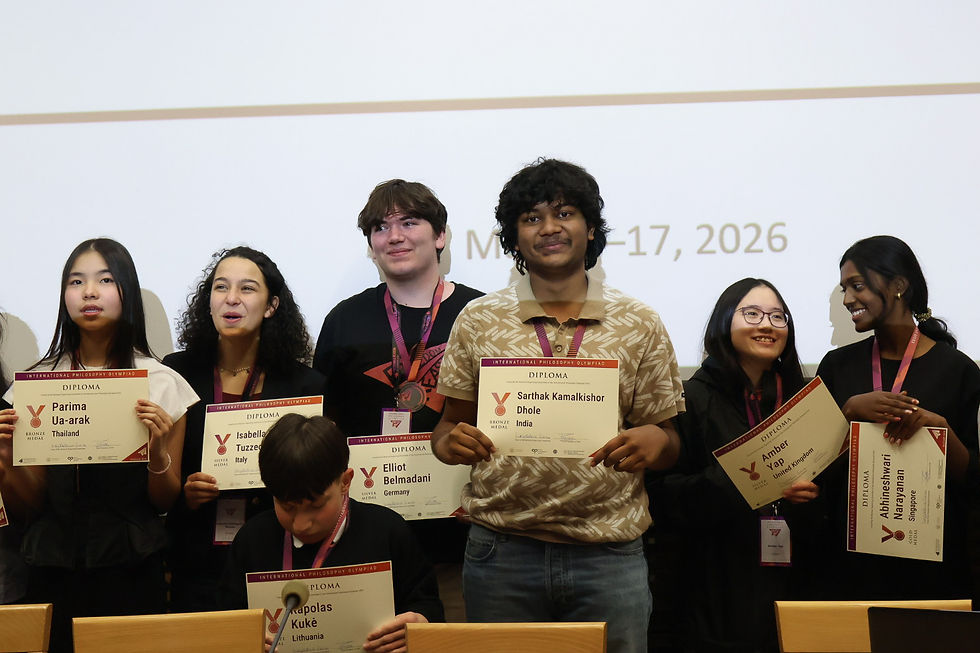
Interview of Sarthak Dhole (winner of Bronze Medal at International Philosophy Olympiad 2026) by Rupesh Singh on preparing for the philosophy competitions and the importance of philosophy in school education.

Sarthak Kamalkishor Dhole is a high school senior at the Jayshree Periwal International School in Jaipur. He has ranked 1st nationally and been on Team India at the International Philosophy Olympiad (IPO) for 3 consecutive years, winning an honourable mention as the youngest awardee (Helsinki, 2024) and a bronze as India’s first medal since 2019 (Warsaw, 2026). The IPO, now in its 34th year, is supported by UNESCO and draws students from 57 countries. He has also won 2 honorary mentions for India at the Baltic Sea Philosophy Essay Event (BSPEE). More about him can be found at his website www.sarthakdhole.com.

Rupesh Singh is a senior doctoral scholar in Philosophy in the Department of Humanities and Social Sciences at IISER Bhopal. His research is situated in the philosophy of quantum mechanics, with a focus on the measurement problem, theory identity, and the interpretation of quantum theory.
Rupesh: Hello, Sarthak. Thank you once again for agreeing to this interview. To begin, could you share a brief account of your background, including where you are from, your academic journey so far, and the interests that currently engage you most?
Sarthak: Hello, Rupesh – thank you for having me; always happy to talk philosophy! I come from the town of Akola in Maharashtra. I studied there till 8th grade at a small CBSE school, then moved to a somewhat larger one in Nagpur for 9th and 10th grade, taking several online courses and participating in competitions to keep up with my interests in science and math. Those competitions are how I ended up on a scholarship for the International Baccalaureate Diploma Programme at Jayshree Periwal International School (JPIS) in Jaipur, where I am now finishing the last year of my high school.
My interests are varied, but they tend to cluster around the disciplines of physics and philosophy. I love to think about things in action and to follow through with abstract reasoning. The disciplines of economics, ethology, synthetic biology, and anthropology, as well as linguistics and robotics, have given me great company. I find the concept of complex systems – in a manner that somewhat represents the Deleuzian concept of the Rhizome – quite fascinating. Employing learnings from one sphere of academia to another and discovering key insights is a very appealing prospect for me, which makes me a big fan of interdisciplinarity. Right now, my thinking is mostly going into Prof. Weatherall’s “puzzleball model” for scientific explanations as I undertake an individual exploration of the discipline under his mentorship, into discovering “new” post-punk music from the 80s, and into my Extended Essay in physics at school.
It's really fascinating to hear about the wide range of experiences you've had and your interdisciplinary interests. I, too, am interested in the interaction between Physics and Philosophy. I was wondering: how did you first come across philosophy, especially since it isn't usually part of formal school curricula? Could you also talk a little about your engagement with it?
Glad we share the interest, and I’m glad Varun sir put us in touch. I must say philosophy of science enthusiasts are few and far between, though over three years, I’ve collected enough of them to run a small reading group on Feyerabend’s Against Method.
Coming to my introduction to the subject, I have always had a general fascination with the questions of bioethics right from the get-go. And when I heard of the Indian nationals for the International Philosophy Olympiad (IPO) 2024, I signed up, knowing very little about what I was getting myself into. Looking back, I think that openness to take on the challenges these thinkers were going to throw at me was quite central to my success at the competition.
I started off by reading What Does It All Mean? by Thomas Nagel, Problems of Philosophy by Bertrand Russell, and Think: A Compelling Introduction to Philosophy by Simon Blackburn, and some combination of these 3 books is what I recommend for most trying to get into the subject. Although having read it much later, I have also found that the novel Sophie’s World by Jostein Gaarder could be just as good, if not better, as an introduction to the subject, as it takes you on a journey through time with all the great thinkers. I’ve been made aware that there exists a graphic novel version of the same, so middle school children may make use of that. Philosophy for Children by Prof. Sundar Sarukkai is also a book I will suggest to the younger enthusiasts. He’s a great author who conveys complex thoughts simply, and someone whom I’ve had the pleasure of talking to over email.
Once I had read these introductory books and a selection of Stanford Encyclopedia of Philosophy articles, and had practised the basics of formal logic and philosophical writing, I appeared for the selections. After qualifying for the training camp, I was inspired to read and write a lot more, especially within epistemology and ethics – disciplines concerning "what is?" and “what should be?" and their connections to each other, especially through intersections such as virtue epistemology. I also read up on topics ranging from philosophy of language and semiotics to philosophy of law and Lacanian psychoanalysis, and started to notice an increasing number of fields that all related back to philosophy. I also credit philosophy with introducing me to social theorists like Mark Fisher, sociologists like Herbert Spencer, legal thinkers like H. L. A. Hart, literary figures like Voltaire, and even AI alignment and scientific pluralism, all of which have influenced me incredibly.
To be able to have engaging conversations about any of these fields, I sought to build a network of like-minded peers. I wanted to do it online because even Nagpur felt like a small city. Together with friends from the Olympiad, I founded Philosium to do just that. It started as a selfish attempt to meet like-minded people but has since transformed into a movement promoting access to quality philosophy education in 60+ countries. Over the last 2 years, I have also been working with the Philosophy Learning and Teaching Organization (PLATO) and the American Philosophical Association (APA) – the U.S. analogue of IPN – to help frame what philosophy education looks like at a pre-university level.
Having run several symposia (in Kleszczów, Budapest, Makarska, etc.), roundtables, lectures, and a podcast and journal, alongside crafting the curriculum for our chapters, I have been fortunate to meet interesting people, collaborate on projects, and have conversations around my topics of passion. After getting feedback from the symposium at the technical school, I noticed the need to expose hardcore STEM students to philosophy as a gateway to discover interdisciplinary problems they can contribute to solving. With that end in mind, I’ve been working, for some time now, under Dr. Debi Talukdar (PLATO & University of Washington) on designing a curriculum (code-named ‘The Snickers Bar Model’) to teach philosophy and science not as disparate fields but as intertwined aspects: philosophy to better conduct and understand science, to see interdisciplinary connections and use these analogies to solve problems, and to identify and deal with the ethical aspects. We hope to pilot the curriculum this fall at experimental pedagogy schools in Pune and the Bay Area.
It's really fascinating to hear about the evolution of your engagement with philosophy, Philosium, and your pedagogy research. Your effort to build a network around philosophical learning is a remarkable initiative in itself. Building on this, for readers who may not be familiar with it, could you explain what the International Philosophy Olympiad (IPO) is, how the Indian national selection process works, and what the overall structure of the Olympiad looks like?
Until the IPO, I had never before experienced such a high density of intellectually stimulating conversations over a period of 4 days. I want you to imagine how it must've felt to first discover the vocabulary through which I was able to think more deeply about all the things I had thought of as a kid – Is my red the same as yours? How do I know everyone else is just as sensitive to pain as me? – and then, meet a cohort of more than 100 people from 50+ countries who have diverse ideas and arguments about the same questions. It is an extremely grounding yet motivating experience.
The Olympiad has been running for 34 years now and is supported by UNESCO and FISP, the highest non-governmental body in philosophy internationally. It brings together competitors from around the world in a philosophical essay writing competition, where one must write a structured essay in four hours on one of the four prompts provided, without access to any materials or sources other than a bilingual dictionary. The Olympiad is usually hosted at a large public university in the capital of the host country, and the essays are to be typed on a computer, with rough sheets provided for effective outlining. Each country selects and sends its two best students for the Olympiad through a national selection process. India has been participating in the Olympiad since 2008.
In Warsaw (2026), I ranked 10th for my essay, which employed tools from the philosophy of language to critically analyse an Aristotelian quote on determinism and the ethics of action. I discussed theories from ethology and economics about actions, and, accounting for cases of moral luck, I proposed an alternate ethical system which also had an epistemic component. As you can tell, it helps to be able to make these cross-disciplinary connections in advancing your case within that time constraint.
The national selections also follow the same structure as the IPO, but the essay contest is 2 hours instead. The national selections also involve a short-answer portion, which is to be used as a tie-breaker from this year onwards, in keeping with the spirit to value philosophical argumentation and writing more than sheer knowledge. The national selections are planned with the idea that one can gain the necessary knowledge of the discipline later, and what must be tested is their command of argumentation, structure, and logic. Much of how I write these essays, I picked up at the national training camp, from Meera ma'am and from the seniors who had been through it before me.
[Editor’s note: Students who are interested in participating the subsequent national-level Philosophy Olympiad examinations, please reach out to Dr Meera Baindur (meera.teaches@gmail.com) and Sarthak (dholesarthak11@gmail.com).]
At the International Olympiad, the contest is just a small part of the event, as there are workshops, discussions, gala dinners and, best of all, excursions planned. I hiked for the first time in my life near Suomenlinna at IPO Helsinki and have cultivated a love for hiking, which led me to hike 2,557 metres high at the Big Almaty Lake after the International Zhautykov Olympiad this January, and later again in Stoos and Niederurnen at the International Young Physicists’ Tournament just last month, which I consider personal achievements like no other.
That's incredible to hear. I'd love to understand more about the preparation behind it. What did your preparation for the national selections and the IPO look like? What kind of guidance or support did you seek along the way? Additionally, could you speak a bit about the nature of the selection process itself, and who is considered a strong candidate?
I understand that I might seem to be downplaying my preparation for the nationals, but I am being honest when I say that I came in having read fairly little formal philosophy outside of reading the 3 introductory texts and engaging a little more in depth with topics that interested me as I worked through those texts.
Back then, I had limited support and just read about those themes that interested me online or occasionally emailed a professor. But now, if I wanted to learn about a specific subfield, I would start by discussing, or rather, philosophising with friends to get insights and then use my responses to their arguments as the initial action potential to read further.
To be a strong candidate at the nationals, I'd say the key thing is to be open. You might have prepared a specific line of argumentation that you tend to follow and stick to (e.g., epistemology-ethics-implications in language/science); however, when you see the prompts, it's best if you forget these pre-prepared notions and start from scratch with just the initial reaction that each of the 4 prompts brings about in you. It's best to write on the prompt to which you have the strongest reaction, and there's absolutely no need to feel pressure to disagree with the quote and find fallacies where there are none to appear to be the 'stronger' thinker. You may just as well agree with the quote, analyzing and perhaps improving on its framing, clarifying its definitions/scope (some quotes may overgeneralize a principle and you can bring them back to size!), and bringing in original insights from other schools of thought by utilizing the tools I talked about earlier, and pinning your insights against the idea in the quote to show which framing is the strongest. This variety in approaches to the prompt is something that is best developed by working through a lot of prompts, and 'through' is definitely a key word because you should ideally take the quote to be a guide that leads you on this journey – not only of analysing arguments but also your own values.
All in all:
Be open to all the quotes.
Note your initial reaction to each quote and write it down as a single sentence. Pick the one you feel the strongest about. Use it as a seed for your thesis.
Plan which domain(s) you wish to address the prompt from, which tools you wish to use, which arguments you want to make, and which implications seem the most interesting. It will be helpful to make an argument tree based on the prompt and to spot any hidden assumptions it makes so that you can attack/support them with your arguments. Having a rough outline will help you score points on coherence.
Consider counter-arguments. Make it a fair fight! Don’t strawman the opposition. A general method to form good counter-arguments is as follows: a. Frame the best argument you can to advance your case. b. Write down each step in that argument’s reasoning. c. Find the weakest link amongst those steps. d. Make a counterargument that attacks this link. e. Respond and defend your thesis against this counter.
Bring in novel analogies/implications in other fields or contemporary lived experience: addiction, technocracy, social media as echochambers, demagogues, etc.
Provide thought experiments in the beginning to set the stage for the specific aspects of the prompt you wish to analyse.
Do effective signposting throughout. Make it clear what you are arguing for, what your burdens of proof are, what tools you are using, etc., early in the essay.
Re-read your essay at the end as if you are reading it for the first time to make sure there are no logical jumps, and that ideas are well illustrated and well prioritised.
You should note that the criteria of evaluation for essays at the Olympiad, as well as the nationals, are: relevance to the topic, philosophical understanding of the topic, persuasive power of argumentation, coherence, and originality. These are weighted roughly equally except for “relevance to the topic,” which is more important because the lack of it will hurt the other scores as well.
It may be important to note that neither the Olympiad nor the national selections have a defined syllabus. However, it may still be helpful to refer to the IB/A-levels Philosophy textbook to get a general overview of the content that might be helpful to know. You would, however, also be in an advantageous position if you are well versed in one or more broader domains – epistemology, ethics, aesthetics, metaphysics – and can use them and thinkers from them to weigh in on the essay prompts in front of you.
I also find it a good strategy to stress more on learning to spot fallacies and use the tools from these domains. Once you have broken down the argument(s) that the prompt posits, you might find it useful to check it for any fallacies and to then subject it to certain tools such as de dicto/de re (that which is said/that which is real) in cases of a linguistic analysis, Hegelian dialectic or Marxist class critique in political analysis, and Nietzschean genealogy for ethics. Of course, you can apply the tools outside the domains they originated in, and their versatility is what makes them good to have in your belt so that you can philosophically analyse arguments whose content is new to you. It also helps to know some formal logic for this end. A good resource for this would be the book The Philosopher’s Toolkit by Julian Baggini.
I’ve also compiled some additional resources and past prompts here.
Building on that, since philosophy can still feel relatively inaccessible in India, especially for school students, what role do you think the academic philosophy community here can play in better supporting young people interested in philosophy and opportunities like the IPO? More specifically, what kinds of mentorship, resources, or support do you feel could make the biggest difference?
I agree with you greatly that philosophy, especially at a high school level, feels inaccessible in India; and even outside of the academic system, if one tries bookstores, the philosophy sections at most establishments are hardly ever different from a range of self-help, devotional, and psychological books – great reads in their own right, but not really what scratches the itch for argumentative philosophy.

This is the precise reason why I co-founded Philosium with 2 friends from the IPO 2024. At our recent conference in Kleszczów, I was pleasantly surprised to see ~450 people – about 10% of the town’s population – show up, as many even came from nearby villages! For our Budapest event, we hosted several roundtables and panels, but the highlight definitely was Prof. John D. Norton’s lecture. Having the chance to listen to a philosopher I had only read about, and actually connecting with them, felt unreal to me. Outside India, I've started and promoted Philosium ventures by partnering with the university philosophy clubs at places like KU Leuven, ELTE University, etc. This is why I believe promoting philosophy clubs at academic institutions, and perhaps giving them a target of outreach for younger students, could be the way to go.
Like Philosium, the IPN too can do a lot to promote philosophy amongst Indian students. There are philosophers across the country who would happily give a school an hour of their time to talk passionately about the problems they have spent years thinking about. Connecting these thinkers with local literature societies, high school clubs, and online reading groups would go a long way.
I also find that several universities abroad, such as the University of Toronto, organize competitions such as the Aristotle Philosophy Essay Contest, bringing together a lot of high school philosophy enthusiasts. I believe Indian universities can adopt a similar approach to the matter – after all, a lot of science and entrepreneurship competitions run by the IITs exist for high schoolers; why not for philosophy?
I also like the PLATO program Philosopher-in-Residence and, although I find it a bit hard to implement, I’m sure that given the enthusiastic academic philosophy community in India, doing symposia like the ones Philosium regularly organizes shouldn't be too difficult. Some techniques we’ve adopted to make these symposia appealing to young students are providing rebates for public transport costs, organizing mini competitions like scavenger hunts and meme contests (as I run a semi-popular philosophy memes page!), and giving journal submitters a chance to give a talk at the symposium. This has helped us gain quite a lot of traction, especially because we partner with local institutions in those regions.
Finally, I would like to see the academic philosophy institutions in my country orchestrate some bootcamps before the IPO nationals such that the training isn’t limited only to the two who qualify to represent the country, and the others can still get exposure to this vastly interesting field. After this introduction, ideally, they should be recommended several paths to guide them along as they go deeper into the discipline – Philosium chapters around the world can help in this matter!
If anyone reading this wants to help run one, register interest on www.Philosium.com, and we will share with you our curriculum, access to our network, and more!
I also think having philosophy clubs and outreach programs across schools and institutions could be a meaningful way to promote greater engagement with the subject. The IPN could be a great platform for facilitating such connections. On a related note, your own journey reflects how philosophy can extend beyond disciplinary boundaries. As a final question, I'd be curious to hear more about this broader influence: how has philosophy shaped the way you approach or engage with other academic fields? Additionally, how have experiences such as participating in the International Philosophy Olympiad and related events influenced you, both intellectually and personally?
I have been lucky to have witnessed many ways of teaching – from my CBSE school in Akola to the IB at JPIS and research fellowships like Non-Trivial to Olympiad training camps. And it was my introduction to philosophy, and especially that of education through thinkers like Paulo Freire and Kurt Hahn, that has made me interested in how I’ve been able to learn things in the academic fields that I, for the most part, discovered independent of the traditional school. I was thus inspired to work with Dr. Debi Talukdar on the curriculum I mentioned earlier – to expose more students to ideas and fields that are unknown to them.
It was also because of my fascination with the works of philosophers, especially those working in environmental ethics – including our Olympiad delegation leader Dr. Meera Baindur herself – that I undertook a project to survey folklore relating to conservation in forest communities, in an attempt to not just study but preserve the folkethics that silently conserves our ecosystems. I got to do fieldwork onsite, practice the method of probing in semi-structured interviews, and learn to analyze qualitative data alongside getting to hear a plethora of interesting stories. I believe philosophy, and reflecting on the nature of learning itself, has enabled me to see these projects as ways of getting exposure to new disciplines and learning new skills, instead of merely reading or competing in competitions!
My philosophy experience has certainly helped me beyond these projects as well. At iGEM, the world’s largest synthetic biology research competition, one of the parts I enjoyed most was ideating ways to minimize the biosafety risk for our innovation. Philosophy has also helped me see connections between fields like economics and ethology, or poker and information theory, and exposed me to the field of complex systems at large, resulting in several hours of intellectually stimulating conversation and perhaps getting ever so slightly better at making sense of how all the different academic fields fit in well with each other.
The Olympiad circles have been instrumental in getting me many opportunities which would otherwise be out of the reach of a young boy from Akola. I was chosen to lead LingHacks – a computational linguistics hackathon – because an IPO alumnus put in a good word. This is probably what led to my deeper interest in semiotics, which formed the basis for my IPO 2025 essay. I was also chosen for scholarships for the IB, at least in my understanding, because of my engagements in these circles. I am also beyond grateful to these communities for helping sustain the projects I started, such as Philosium and BetterTGT.
Other than these learning aspects and opportunities, the Olympiad communities have been the source of some of the most memorable experiences of my life. I feel that when I am old, I will still periodically look back on the film pictures from a dozen of these events and be able to see how each of those amazing people, beautiful conversations, fierce intellectual debates, gruelling hikes, tiring physics fights, exciting scavenger hunts, funny memes, and laid-back karaoke sessions shaped me into the person I will be then. I will probably also thank these communities in my PhD thesis in the future, just like my mentor Dr. Abhishek Dedhe (IPO 2014-15) did.
As we come to the end of the interview, this feels like the right moment to recognize the thinkers and mentors behind India's medal at the IPO this year. I’d especially like to thank Dr. Meera Baindur and Dr. Mani Sachdev, for leading the nationals and for all the reading recommendations; Dr. Souhardya De, Dr. Abhishek Dedhe, Dimitrije Golubović, and Arth Gupta, for their guidance on academic writing and introducing me to research areas I never knew existed; and Ayesha Malik, Neil Tripathi, and Gauri Gupta – my teammates from the last 3 years – for being a constant source of inspiration and fresh ideas. I’d also like to express my gratitude to UNESCO, FISP, the executive and organizing committees of the 32nd-34th IPOs, and the hundreds of volunteers whose efforts culminated in the organization of this wonderful event. I hope to return and contribute to the Olympiad community. Thank you to the IPN for the opportunity to reflect on these moments and for its work in promoting philosophy in India.